
Reviewed · TOURS IN CAIRO
2 Days Tour to Around Cairo Attractions
Cairo’s greatest hits come in a brisk two-day sweep: royal tombs, enormous pyramids, medieval mosques, Coptic churches, and the museum’s famous Tutankhamun collection. The best part is having an Egyptologist guide explain what you are seeing instead of leaving you to sort out thousands of years on your own. I also like the private pickup and the flexibility to shape parts of the day around your interests.
The strongest practical benefits are the easy hotel transport and the guides’ personal touch. Guides named in the feedback, including Mimmo, Mohammad, Amir, Massimo, and others, are praised for clear explanations, good photographs, local food advice, and adjusting the pace. The tradeoff is simple: this is a packed program, and Cairo traffic, heat, walking, and extra admission fees can make two long days feel demanding.
Key points at a glance
- Two very full days: You cover central Cairo, Old Coptic Cairo, the Citadel, Giza, Sakkara, and the advertised Memphis stop.
- Private tour with pickup: Collection and return are offered from accommodation in Cairo or Giza, with a maximum group size of 15.
- A guide-led museum visit: The Egyptian Museum holds more than 250,000 objects, including a special collection linked to King Tutankhamun.
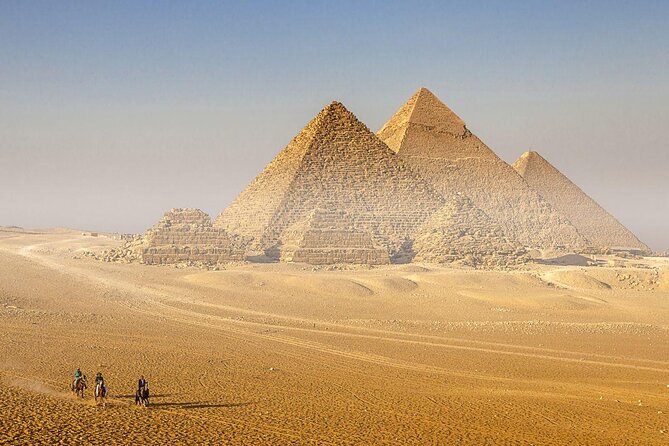
- The big pyramid trio: Your guide introduces Cheops, Khafre, and Menkaure at the Giza Plateau, followed by the Sphinx and Valley Temple.
- Local touches matter: Fresh juices, falafel, food recommendations, and helpful photographs are recurring parts of the experience.
- Good value, with extras to budget: At $165 per person, lunch and transport are included, but entrance fees, taxes, accommodation, visa costs, and tips are not.
Why this two-day Cairo plan works
Cairo can feel like several cities packed into one. Ancient royal monuments sit beside medieval fortifications, Christian churches, crowded streets, and modern neighborhoods. That variety is the reason to choose a guided plan like this one, but it is also why the schedule feels busy.
Day one focuses on the city itself. You begin at the Egyptian Museum in Tahrir Square, then continue to Saladin’s Citadel and the Alabaster Mosque of Muhammad Ali. The day also includes Old Coptic Cairo, according to the tour overview, giving you a useful look at Cairo beyond the pyramids.
Day two moves west and south. You visit the Giza Plateau, the Sphinx, and the Valley Temple before continuing to Sakkara and the ancient capital of Memphis. This creates a sensible historical sequence: major royal monuments, then older pyramid-building sites and the remains of an earlier capital.
You are picked up around 7:30 a.m. from your Cairo or Giza accommodation. That early start is useful because the route covers a lot of ground. It also means you should eat breakfast before leaving or confirm how the morning meal fits your plans. Lunch is included on both days, but the exact restaurants and menu are not specified.
A few more things to do in Cairo worth a look
- White & Black Desert tour 2 Days 1 night camping from Cairo.
★ 5.0 · 649 reviews - Cairo: 2-Day Bahariya Oasis Camp and Desert Tour
★ 4.9 · 616 reviews - White & Black desert camping tour 2 Days 1 night From Cairo
★ 5.0 · 467 reviews
The Egyptian Museum and its 250,000 objects
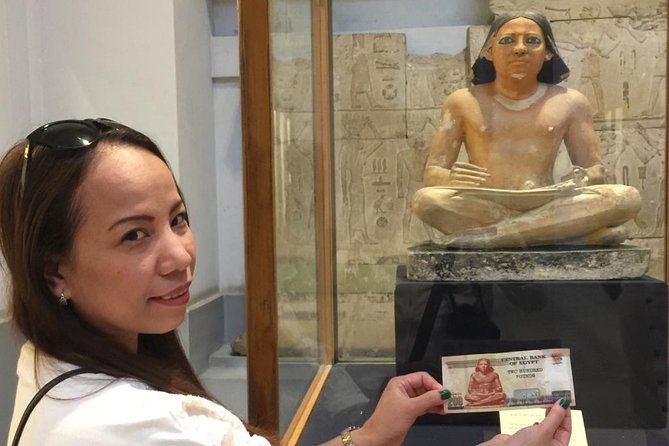
The Egyptian Museum is the natural first stop because it gives you the objects and stories needed to understand the monuments that follow. It contains more than 250,000 genuine artifacts dating back roughly 5,000 years, with a notable collection dedicated to King Tutankhamun.
I like this order. Seeing statues, burial objects, and royal pieces before visiting the pyramids helps you connect the museum displays with the places where ancient rulers were buried and honored. A guide can also prevent the visit from becoming a march past display cases with no sense of what matters.
Allow yourself mental space here. The museum is not a small, tidy collection where every object receives equal attention. It is a large historic institution, and the number of objects can be tiring. Your guide’s job is especially useful in this setting: ask for the most important pieces, the Tutankhamun highlights, and enough time to look closely rather than simply follow a route.
The museum is in central Cairo, at Tahrir Square, so this stop also puts you in the middle of the modern city. That contrast is part of the experience. Ancient royal art is followed by streets, traffic, and daily Cairo life, a reminder that the city is not an open-air archaeological park.
Saladin’s Citadel and Muhammad Ali’s mosque
The Citadel of Saladin was built in the 12th century as a major defensive complex. It contains several important monuments, including the Alabaster Mosque of Muhammad Ali, the Mosque of Suleiman Pasha, and sections of the walls associated with the Citadel.
The Alabaster Mosque is the main visual prize here. Its pale stone, large open interior, and prominent domes give the visit a very different feel from the museum and pyramid sites. You are shifting from pharaonic Egypt to medieval and Ottoman-era Cairo, and the change is valuable.
The listed route also includes Joeh’s Walls and references Muhammad Ali Pasha. Some details of the stop may depend on opening conditions and the time available, so do not assume every corner of the complex receives the same amount of attention. Ask your guide what is open and which monuments deserve the most time that day.
Dress smart casual, as requested for the activity. Covering shoulders and knees is a sensible choice for mosque visits, and comfortable shoes matter because this is a sightseeing day with repeated walking and standing. The tour information does not give exact distances or stair counts, so anyone concerned about mobility should ask the operator before booking.
Old Coptic Cairo adds a needed change of pace
The tour overview includes Old Coptic Cairo, giving you a look at one of the city’s Christian quarters. This is an important addition because a Cairo visit built only around ancient Egypt can give you a narrow picture of the city.
Here, the interest is not only in individual buildings. You see how different religious and historical layers sit close together within Cairo. The experience is more intimate than the huge Giza Plateau, and a guide can explain why the area matters without asking you to decode every church or lane alone.
The exact Coptic sites are not listed in the supplied details, so treat this as a planned area visit rather than a promise of a particular church interior. If Old Coptic Cairo is a priority, confirm which buildings are included when you book. The same applies to time: the itinerary has several major stops, so the schedule may favor a focused visit over a long, unhurried exploration.
Same base, a different sort of day:
- Cairo: Pyramids & Great Sphinx Private Tour with Camel Ride
★ 4.9 · 6,335 reviews - Tour to Giza Pyramids and The Egyptian Museum
★ 5.0 · 6,016 reviews - VIP All inclusive Best of the best Giza Pyramids,Sakkara,Memphis
★ 5.0 · 3,164 reviews - From Cairo: Pyramids of Giza, Sphinx, Saqqara & Memphis Tour
★ 4.7 · 3,110 reviews
Giza: Cheops, Khafre, Menkaure, and the Sphinx
Day two begins at the Giza Plateau, about 30 minutes from Cairo under normal conditions. Traffic can change that estimate, but the short stated distance makes the morning transfer manageable compared with a trip from farther away.
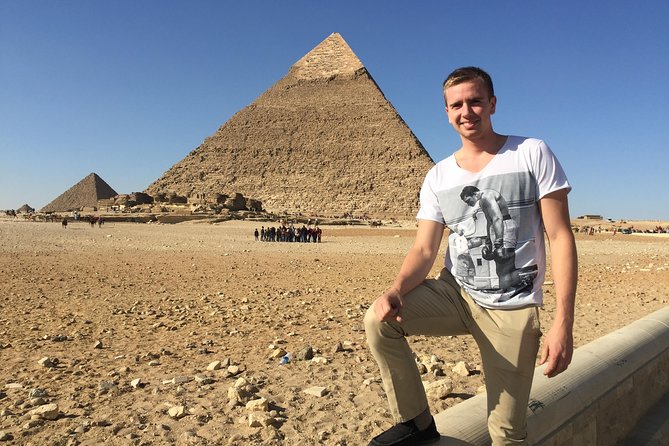
Your Egyptologist guide introduces the three main pyramids: Cheops, Khafre, and Menkaure. Cheops, also called the Great Pyramid, is the largest and most famous. Khafre is often recognized by its remaining casing stones near the top, while Menkaure is smaller but still part of the essential Giza group. The value of a guide here is not just naming them. You can ask about their different sizes, positions, and roles within the plateau.
The pyramids are far more impressive in person than in photographs, but the visit is not passive. Expect sun, open ground, uneven surfaces, and plenty of standing. Bring water, wear practical shoes, and protect yourself from the heat. The tour does not state that interior pyramid entry is included, so check the entrance arrangement before you go and budget for any optional ticket.
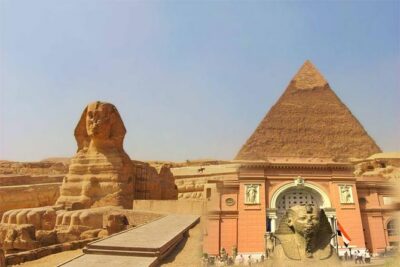
The Sphinx is a short distance toward the city side of the plateau. For thousands of years it has served as one of Egypt’s defining symbols, with a lion’s body and human head. It is smaller than many first-time visitors expect, but its setting beside the pyramids gives it great power.
The nearby Valley Temple belongs to Khafre’s pyramid complex. Its heavy stone construction helps you understand that Giza was not only a pyramid field. It was a carefully planned funerary center with temples, processional routes, and spaces for rituals.
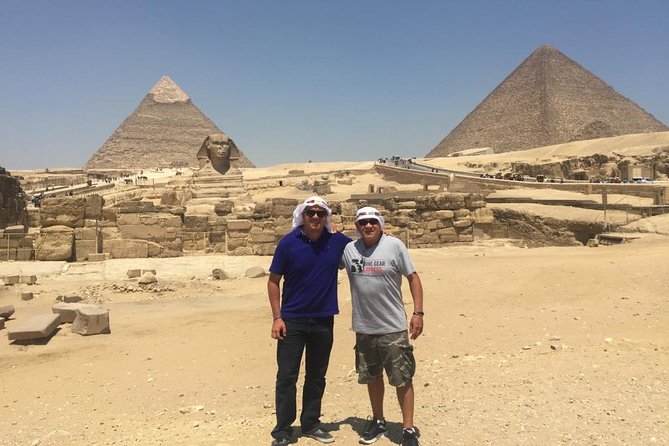
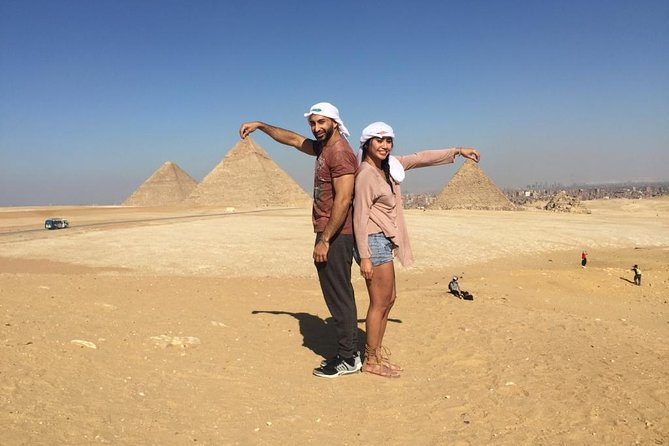
This is also where the guides’ photography skills can matter. Several guide names, especially Mimmo and Mohammad, are praised for taking photographs and helping couples or families get pictures together. That is a useful practical benefit when you are traveling without someone else to operate the camera.
Sakkara and the earliest major stone pyramid
After Giza, you continue to the Sakkara necropolis. The advertised route identifies it as home to the world’s oldest major stone structure, the Step Pyramid of Djoser. This site takes you further back in the development of pyramid construction and helps explain how Egyptian builders moved from earlier burial forms toward monumental stone architecture.
The route also mentions the Mastabas of Ti. Mastabas are flat-roofed tomb structures, and their decorated interiors can show daily life, work, food, animals, and ceremonies in a way that a massive pyramid cannot. This is one reason Sakkara can be more revealing than simply adding another large monument to your schedule.
Sakkara requires patience. It is a broad archaeological area, not one compact building, and the exact order of stops can vary. The available description does not specify how long you spend inside each tomb or which entry tickets are included. Ask about the Mastaba of Ti and the Step Pyramid before departure so you know what your admission covers.
I also appreciate the historical progression here. Giza gives you the famous royal monuments, while Sakkara shows an earlier stage of Egyptian architecture. You are not just collecting photographs. You are seeing how monumental building changed over time.
Memphis fills out the ancient capital story
The tour overview includes Memphis, the ancient capital of Egypt, after the Giza portion and alongside Sakkara. The detailed stop description gives more attention to Sakkara, so confirm the exact Memphis visit and timing before booking. It is an important point if seeing the old capital is one of your main reasons for choosing this tour.
Memphis adds context because the pyramids were not isolated sites. They belonged to a wider political and religious world centered on a major capital. Even a shorter stop can help connect the necropolis at Sakkara with the city that supported it.
Because the day already includes Giza, the Sphinx, the Valley Temple, and Sakkara, Memphis may make the afternoon particularly full. That is not necessarily a flaw, but it is a reason to set realistic expectations. You will see a great deal, but this is not a slow archaeological study tour.
What the guides add to the experience
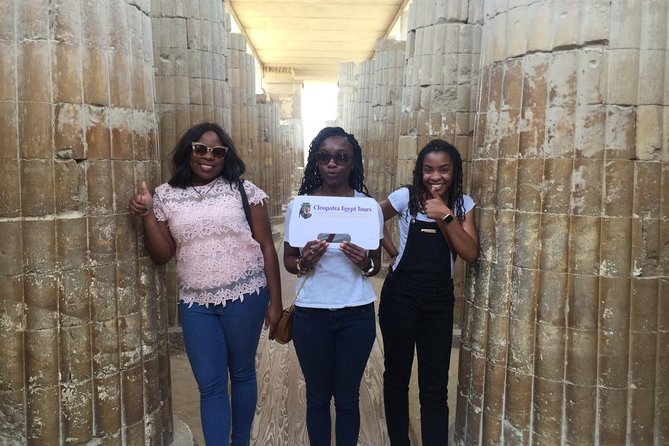
The guide is the main factor that shapes this tour. The listed guides include Mimmo, Mohammad, Amir, Massimo, Bassim, and others, and the feedback repeatedly highlights friendly service, clear explanations, good humor, and flexibility.
Mimmo receives especially strong attention for energy, photography, local recommendations, and making the day feel easy. Mohammad is praised for being kind, funny, informative, and helpful with photographs. Amir is singled out for the pyramid visit, while Massimo is noted for patiently helping with economical tour planning.
You should still remember that guide assignment is not guaranteed unless confirmed. The booking information names several people through the available feedback, but it does not promise one particular guide. If you have a preference, ask before paying.
The personal touches are useful in Cairo. Fresh juices, falafel, and food suggestions are mentioned as part of the experience with some guides. Lunch is included, but these extra local food stops or recommendations may vary by guide and day. If you have allergies, dietary restrictions, or strong food preferences, raise them early.
Price, inclusions, and the real value
At $165 per person, this is a strong value for a two-day private tour with hotel pickup and drop-off, an Egyptologist guide, private transport, and two lunches. You are paying for coordination as much as sightseeing. Cairo’s distances, traffic, and scattered monuments can be difficult to manage independently in a short visit.
The price does not include all costs. Accommodation, an Egyptian entry visa, entrance fees, taxes, and optional gratuities are excluded. That matters because the headline price is not your final Cairo budget. Ask for a current list of admission charges before booking, especially if you want to enter any pyramid or additional monument.
The phrase private tour appears in the inclusions, while the activity also lists a maximum of 15 participants. In practical terms, this appears designed as a private booking that can accommodate a group of that size, rather than a large public coach tour. Confirm the vehicle and group arrangement if you are booking as a couple or small family and want private use throughout.
Two lunches help keep the days moving, though meal choices are not specified. The included pickup is another real advantage. You do not need to arrange separate taxis for the museum, Citadel, Giza, and Sakkara, and you return to your Cairo or Giza accommodation after each day.
Who should book this Cairo tour
I would choose this tour for a first Cairo visit, especially if you have only two days and want the major ancient and Islamic sights covered without building your own transport plan. Families may also appreciate the door-to-door pickup and the presence of an adult guide throughout the day. Children must be accompanied by an adult.
It suits people who want explanations, photos, and practical help more than complete independence. The guide can adjust parts of the day, and several guides are praised for responding to requests. That flexibility is valuable if you care more about the museum than an extra monument, or if you want time for photographs at Giza.
I would be cautious if you dislike early starts, long sightseeing days, heat, or a fixed route. The itinerary is ambitious, and entrance fees are not included. It is also not the best choice if you want a slow, specialized visit focused only on ancient architecture or only on Islamic Cairo.
Confirmation is provided when booking. Free cancellation is available up to 24 hours before the start time, with the local start time controlling the cutoff. Last-minute cancellations or changes are not accepted for a refund.
Should you book it?
Book this tour if you want Cairo’s major sights handled efficiently, with a guide, vehicle, hotel pickup, and lunch included. The combination of Giza, Sakkara, Memphis, the museum, the Citadel, and Old Coptic Cairo gives you a broad first look at the city in just two days.
Before paying, confirm the exact entrance fees, the Memphis stop, the sites included in Old Coptic Cairo, and whether a particular guide such as Mimmo, Mohammad, or Amir is available. If you accept a busy schedule and budget for extras, the $165 price offers a practical way to get a lot from a short Cairo stay.
FAQ
Where does the tour begin?
Pickup is offered from accommodation in Cairo or Giza. The listed start time is 7:30 a.m.
How long does the experience last?
The tour lasts approximately two days, with a separate sightseeing program on each day.
Is transportation included?
Yes. Hotel or port pickup and drop-off are included, along with private transportation for the tour.
Are meals included?
Lunch is included on both days. The specific restaurants and menus are not stated.
Are entrance fees included?
No. All fees and taxes are listed as excluded, so you should confirm current monument and museum admission costs before booking.
Can I cancel for a full refund?
Yes, if you cancel at least 24 hours before the experience start time. Cancellations or changes made less than 24 hours in advance are not accepted for a refund.
Just added in Cairo
- White Desert Overnight Camping Sharing Tour in Egypt★ 5.0 · 15 reviews
- Cairo Best 2Days tour Pyramids, Saqqara & Old Cairo★ 5.0 · 15 reviews
- Giza Pyramids with (GEM) Grand Egyptian Museum★ 5.0 · 42 reviews
- visit the pyramids of Giza + the necropolis of Saqqara + the Memphis site.★ 4.5 · 20 reviews
- Tour to Giza pyramids Memphis Sakkara and Felucca on the Nile★ 5.0 · 16 reviews
- Private Giza pyramid,sphinx, Mummification temple& inside pyramid★ 5.0 · 32 reviews
- Monastery St Simon with Cave Church and Garbage City Private Tour★ 5.0 · 15 reviews
- sunset at Giza pyramids by camels★ 5.0 · 31 reviews
Tours in Cairo, compared.
Pyramids & Great Sphinx Private Tour with Camel Ride
Read our review →
Tour to Giza Pyramids and The Egyptian Museum
Read our review →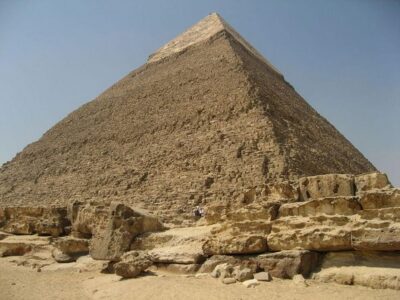
VIP All inclusive Best of the best Giza Pyramids,Sakkara,Memphis
Read our review →
Pyramids of Giza, Sphinx, Saqqara & Memphis Tour
Read our review →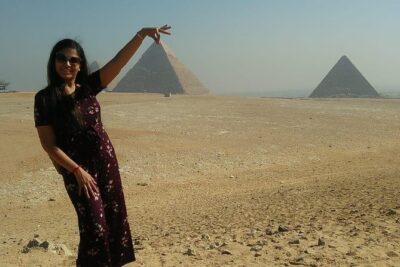
Cairo 8 Hour Private Tour of Pyramids, Egyptian Museum and Bazaar
Read our review →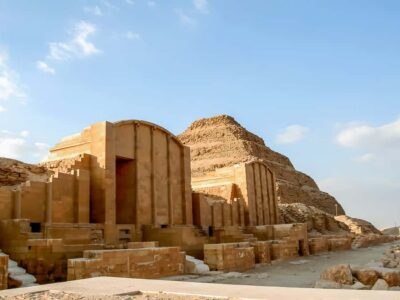
Private ViP all-inclusive Giza Pyramids,Sphinx,Inside Pyramid
Read our review →
Grand Egyptian Museum, Pyramids, Sphinx Tour & Lunch
Read our review →Browse the lists this tour appears in