
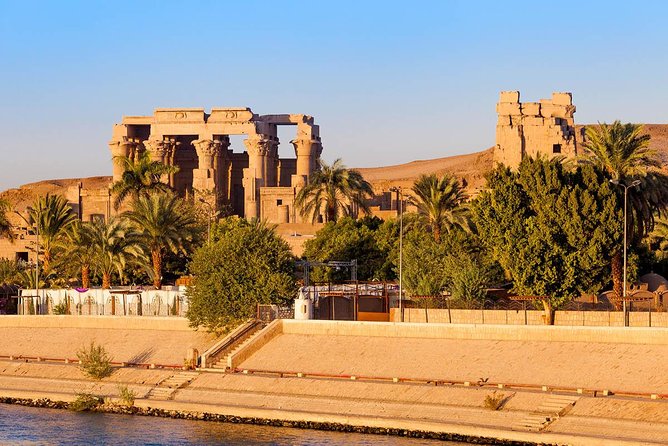
Reviewed · ABU SIMBEL TOURS
2 days 1 night Luxor,Aswan & Abu simbel by flight from Cairo
The main attraction here is simple: in two very long days, you see Abu Simbel, Aswan, and Luxor, three of southern Egypt’s biggest sights. The schedule starts before dawn and keeps moving until the return flight to Cairo, but it covers an impressive amount of ground without asking you to arrange flights, cars, hotels, or entrance tickets yourself.
I like the private air-conditioned vehicle, which gives you room to rest between monuments, and I like the guide support at each destination. Guides including Ahmed, Samir, Aida George, Ghada, Hamees, and DoA have been praised for clear explanations and good care. The main drawback is the pace: changing pickup times, delayed flights, long drives, and a very early start can turn this into an endurance test.
Key points at a glance
- Abu Simbel comes first: After landing in Aswan, you drive about three hours each way to reach Ramesses II’s great temple and the smaller temple of Queen Nefertari.
- One private car covers the hard miles: You travel by air-conditioned vehicle with a personal driver rather than joining a large coach group.
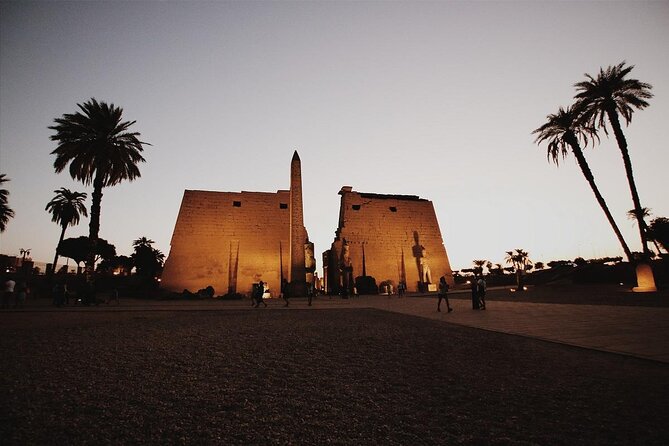
- The itinerary hits Egypt’s major southern sights: Philae, the High Dam, the Unfinished Obelisk, the Valley of the Kings, Hatshepsut’s temple, Karnak, and Luxor Temple are all included.
- The schedule is extremely tight: A 4 a.m. Cairo pickup, long road transfers, and a full Luxor sightseeing day leave little time for sleep or wandering.
- The price bundles a lot: At $500 per person, the package includes domestic flights, private transfers, guides, hotel, lunch, bottled water, and entry fees.
- Communication needs attention: Confirm every pickup and flight detail in advance, since timing changes and airport coordination have caused problems for some bookings.
A two-day route through Egypt’s greatest temples
This is not a gentle southern Egypt holiday. It is a carefully packed sightseeing sprint.
You leave your Cairo or Giza hotel at about 4 a.m. A representative waits in the lobby with a sign bearing your name, then takes you by private car to Cairo Airport. After the flight to Aswan, another guide meets you at the airport and the road portion begins.
That arrangement is useful because you are never expected to find the next driver or negotiate a taxi after landing. It also means you need to keep your phone available and confirm the handoffs before departure. The tour has worked very well for people who received clear updates, but some schedules changed without enough warning.
Other Abu Simbel runs from Cairo:
- Our Exceptional 5 days Cairo, Luxor and Abu Simbel Tour Package
★ 5.0 · 212 reviews - From Cairo: 2-Day Abu Simbel & Luxor Tour
★ 3.9 · 136 reviews - 3 Night Luxor and Aswan Nile Cruise with Hot Air Balloon, Abu Simbel from Luxor
★ 5.0 · 76 reviews
Abu Simbel makes the long first day worthwhile
The drive from Aswan to Abu Simbel takes about three hours. That is six hours on the road in total, so this is the day’s biggest tradeoff. You lose time to the desert highway, but the reward is one of Egypt’s most memorable ancient sites.
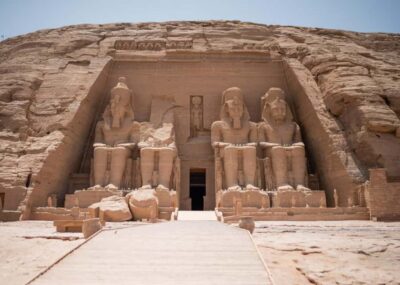
The main temple was built by Ramesses II and is dedicated to Ptah, Re-Her-Akhtey, Amun-Re, and Ramesses himself. Its huge seated figures make an immediate impression, but the interior is just as important. Your guide can explain the religious images, royal symbolism, and the connection between the temple and the sun.
The neighboring temple belongs to Queen Nefertari and is associated with Hathor. Seeing both temples together helps you understand how Ramesses presented his queen and himself as part of a divine royal family. The famous sunlight effect inside the main temple occurs twice a year, on October 22 and February 22, according to the tour information.
You receive an admission ticket and a guided visit. Give yourself permission to focus on the main halls, statues, and wall scenes rather than trying to absorb every detail. After the long drive, the heat and early start can catch up with you.
Aswan’s three major stops before dinner
After Abu Simbel, you return toward Aswan for a compact city visit. The listed route includes the High Dam, the Unfinished Obelisk, and Philae Temple.
The High Dam is a modern engineering landmark rather than an ancient monument. It reshaped the Nile and helped control flooding and power production, but it also changed the river valley and forced the relocation of important monuments. That background makes it more than a quick photo stop.
At the Unfinished Obelisk, you see how stoneworkers began cutting a massive monument directly from the bedrock. The cracks that ended the project remain visible. It is a useful stop because the site shows the practical side of Egyptian monument building, not just the polished final product.
Philae is the day’s ancient highlight in Aswan. The temple complex is dedicated chiefly to Isis and has a dramatic setting associated with the Nile islands. The supplied schedule lists the stop under Temple of Philae, while the wider itinerary includes all three Aswan sights. Confirm the exact order with your guide because flight times and road conditions can alter the plan.
You spend the night at Basama Aswan Hotel, described as a four-star hotel in the tour details. One Spanish-language account described a different hotel as a five-star property, while another account noted that the hotel did not match the accommodation described. I would treat the named hotel as the intended stay, but confirm it before departure if the room standard matters to you.
What the private vehicle changes
The private car is one of the strongest features of this trip. You are not tied to a large group’s pace, and you can rest during the long Abu Simbel and Aswan to Luxor transfers. Several accounts praised the drivers, with one specifically noting safe driving and another describing the same driver as excellent across both days.
The car does not make the distances short. It simply makes them less tiring. You still need to prepare for long stretches of road, a dawn departure, and a second full sightseeing day.
A private tour also means your group travels alone, rather than sharing the sightseeing experience with a large busload. That can help at crowded monuments and makes the guide’s explanations easier to follow. Guide quality can vary by assignment, so state your preferred language and ask who will guide each day.
Guides named in the supplied experiences include Ahmed, Samir, Mustafa, Mohamed, Shereen, Ghada, Aida George, Hamees, Daria, DoA, Maria, and Mona. Several were praised for strong explanations and friendly service. One account specifically praised Hamees for explaining the main points before allowing time for photographs, while another praised DoA for giving detailed historical context. There was also a complaint about a guide who did not enter the monuments with the group, so expectations should be confirmed early.
Other trips that fly out of Cairo for the day:
- Cairo: Private Luxor Day Tour with Entrance fees by Flights
★ 4.4 · 644 reviews - Full-Day Luxor private Tour from Cairo by Plane with Lunch
★ 5.0 · 446 reviews - Day Trip To Luxor From Cairo By Plane
★ 4.5 · 393 reviews - Day Trip to Luxor From Cairo By Flight, King Tut Tomb Included
★ 4.5 · 270 reviews
From Aswan to Luxor and the Valley of the Kings
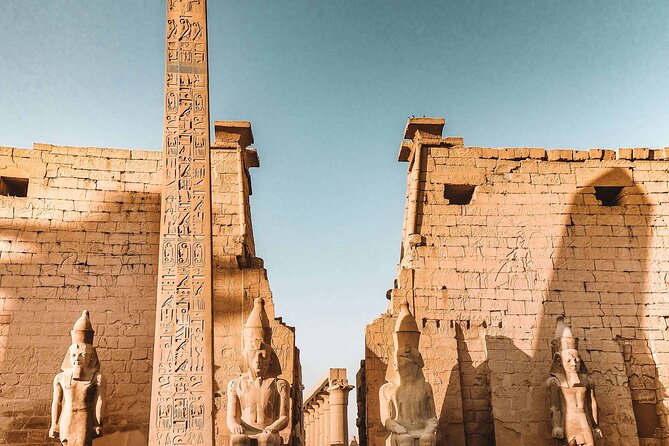
Day two begins with a road transfer from Aswan to Luxor. The itinerary does not give a precise driving time, but this is another substantial overland journey. You then begin on Luxor’s West Bank, where the Valley of the Kings is the centerpiece.
The Valley contains tombs from several dynasties. The entrance ticket is included, but the details of which tombs are open or included can vary. Ask your guide which tombs are available that day and which ones require an extra ticket, since the standard entry does not necessarily cover every special tomb.
The valley is not a place to rush through without looking up. Painted scenes, burial symbols, and carved passages explain how Egyptian rulers prepared for the afterlife. Your guide’s help matters here because the visual details can seem confusing without a basic explanation of the gods, rituals, and royal names.
The heat can be serious, and the walk from the visitor area to individual tombs may be tiring. Wear practical shoes, carry the supplied water, and keep your expectations realistic. You will see a great deal, but you will not have unlimited time in every tomb.
Hatshepsut and the Colossi of Memnon
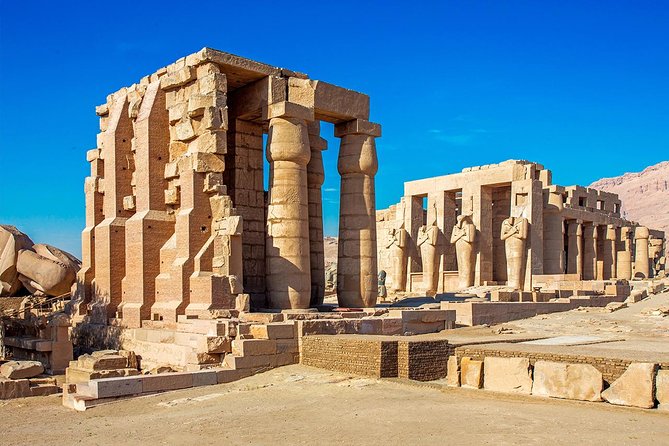
The Temple of Hatshepsut at Deir el-Bahari follows the Valley of the Kings. Its terraces rise against the cliffs, creating one of Luxor’s most striking settings.
Hatshepsut ruled for about 20 years during Egypt’s 18th Dynasty. Her temple presents her as a legitimate ruler and links her reign to the gods and the royal line. Your guide can point out the terraces, reliefs, and the way the structure uses the natural cliff behind it.
The visit is listed at about two hours, although the actual timing depends on the day’s road movements and flight schedule. You should use this stop to look across the terraces and listen to the explanation before taking photographs. The site is more rewarding when you understand why Hatshepsut’s image and royal titles mattered.
The Colossi of Memnon are a short stop, listed at about 30 minutes. These two enormous seated statues once guarded the mortuary temple of Amenhotep III. The temple itself has largely disappeared, so the statues work best as a quick historical marker and photo stop rather than a long visit.
Karnak is the day’s largest ancient complex
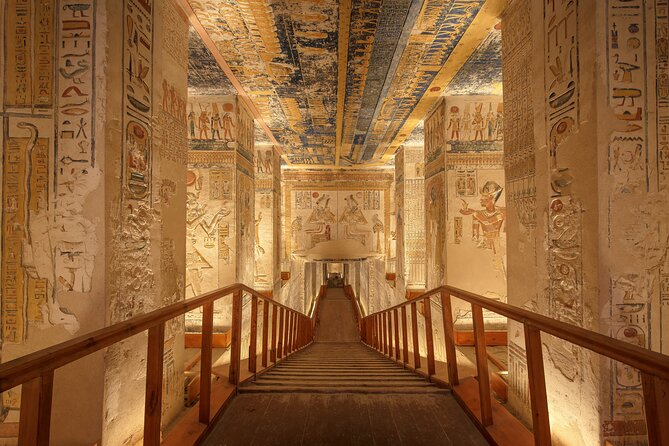
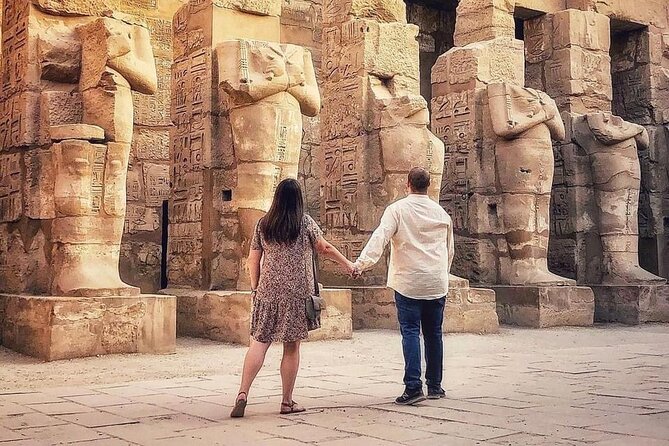
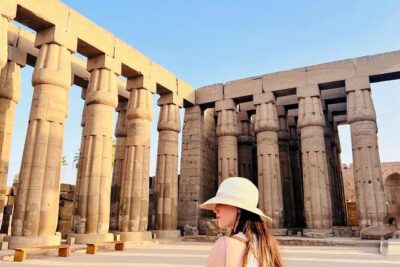
On the East Bank, Karnak gives you the grand scale that smaller temple visits cannot match. The complex developed over several reigns and includes the Avenue of Sphinxes, the Hypostyle Hall, obelisks, the temple of Amun, a sacred lake, and other structures.
The Hypostyle Hall is the visual showpiece. Its forest of 134 huge columns makes the space feel larger than photographs suggest. Look closely at the carved surfaces, since lotus and papyrus designs help explain the symbolism of the hall.
The itinerary also calls out the obelisks of Hatshepsut and Thutmose III, the granite scarab associated with Amenhotep III, and the sacred lake. These details give your guide plenty to explain, but the stop is listed at only about one hour. That is enough for the main route, not for a slow, complete exploration.
Karnak is where a good guide can make the biggest difference. A strong explanation helps you connect the separate gateways, halls, statues, and sanctuaries. Without one, it is easy to see only a long series of stones.
Luxor Temple closes the sightseeing day
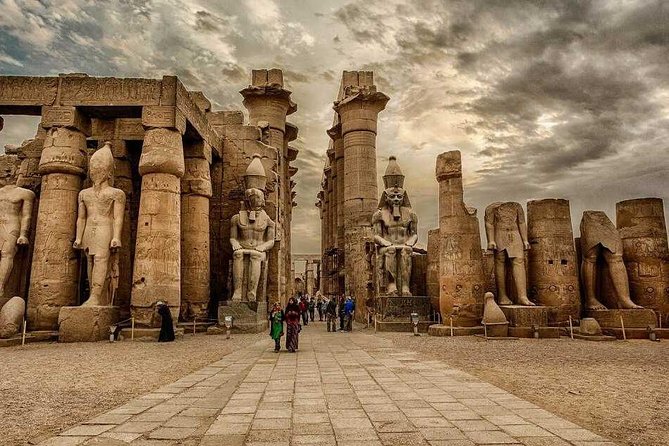
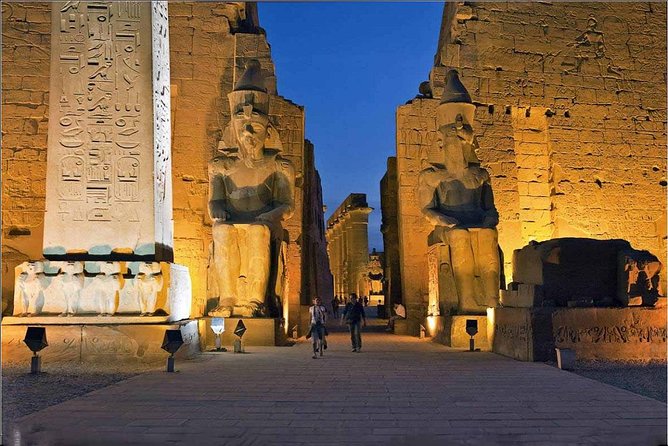
Luxor Temple was begun under Amenhotep III and completed under Ramesses II. Unlike Karnak, it feels more compact and direct, with courtyards, colossal statues, and a strong processional layout.
The tour places Luxor Temple near the end of the day before the transfer to Luxor Airport. That timing gives the visit a natural finish, but it also means fatigue may be setting in. If your flight is late, you may have more time. If the flight is early or delayed earlier in the itinerary, the stop may be shorter.
After the temple, you go to Luxor Airport for the domestic flight back to Cairo. A representative is supposed to meet you at Cairo Airport and transfer you to your hotel. Confirm this final pickup, since one account reported waiting about 20 minutes before the driver arrived.
What $500 includes, and what it does not
At $500 per person, this is not the cheapest way to see southern Egypt. It is also not a simple sightseeing ticket. The price covers roundtrip domestic flights, hotel pickup and drop-off, private air-conditioned transfers, guides, admission fees, lunch, bottled water, and one hotel night.
That bundle can offer good value if you are starting in Cairo and have only two days. Arranging the same chain of flights, airport transfers, road transport to Abu Simbel, private guiding, hotel, and Luxor transport would take time and would not necessarily cost less.
The value is strongest for a first visit when you want the major monuments rather than a slow Nile journey. It is weaker if you prefer quiet mornings, extended museum visits, independent wandering, or time to sit beside the river. A Nile cruise takes longer but gives you a more relaxed sense of the region.
Tipping is not included. Visa entry is also excluded, so you need to handle those costs separately. Lunch is included, although the choice of restaurants has not been consistent enough for me to treat the meals as a major reason to book.
The schedule requires careful preparation
The first pickup is listed at 4 a.m., and some departures may be even earlier depending on the flight. You should confirm the exact hotel pickup time, airline schedule, airport meeting point, guide name, and hotel before you leave Cairo.
The tour operator has used WhatsApp for updates and support, and some people received quick replies at any hour. Others had trouble getting clear information about changed pickup times, flights, and transfers. Keep all confirmations in writing and ask for a complete two-day schedule rather than relying on last-minute messages.
The tour is marked as suitable for most people, but the physical and mental demands are real. You need to manage early mornings, walking around temple grounds, heat, long drives, and a late return to Cairo. The private vehicle lets you rest, but it cannot replace sleep.
Cancellation terms are strict near departure. Cancel at least six full days before the start time for a full refund. Cancellation two to six full days before departure allows a 50 percent refund, while cancellation less than two full days before the start receives no refund. Poor weather may lead to another date or a full refund.
Who should book this southern Egypt sprint
I would choose this tour if you have limited time in Egypt and want the biggest ancient sites in one organized package. It suits independent people who still want private transport and a guide, especially if you are comfortable with early starts and a packed schedule.
It is also a good fit if Abu Simbel is a priority. Reaching it independently from Cairo requires more planning, while this arrangement links the flight, road transfer, temple visit, and Aswan hotel in one route.
I would not choose it for a slow, restful holiday. Families with very young children, anyone who struggles with long road journeys, or anyone who wants time for markets, museums, and unplanned stops may find the pace too hard.
Should you book it?
Book it if your aim is to see the maximum number of major monuments in two days and you accept that the trip will feel intense. The strongest parts are the private transport, the broad coverage, Abu Simbel, and the chance to use guides such as DoA, Aida George, Hamees, Ahmed, or Samir, depending on assignment.
Before paying, ask for the exact flights, pickup times, hotel confirmation, guide languages, and full list of included entry tickets. If the operator provides those details clearly, $500 can be a sensible price for this much transport and guiding. If you need flexibility and rest, add more days or choose a slower Nile-based plan instead.
FAQ
How long is the tour?
The experience lasts approximately two days and includes one overnight stay in Aswan.
Where does the tour start?
Pickup is offered from hotels in Cairo or Giza City. The first listed pickup time is 4 a.m.
Are flights included?
Yes. The package includes flights from Cairo to Aswan and from Luxor back to Cairo.
What hotel is included?
The tour information names Basama Aswan Hotel for the one-night stay and describes it as a four-star hotel.
Is Abu Simbel included?
Yes. The tour includes admission and guided visits to the temples of Ramesses II and Queen Nefertari at Abu Simbel.
Is transportation private?
Yes. Transfers are provided by private, air-conditioned vehicles with a personal driver, and the tour is reserved for your group.
What is included in the price?
The price includes a tour guide, hotel pickup and drop-off, private transfers, domestic flights, entrance fees, bottled water, lunch, and the hotel stay.
Is tipping included?
No. Tipping is not included in the tour price.
Just added in Cairo
- White Desert Overnight Camping Sharing Tour in Egypt★ 5.0 · 15 reviews
- Cairo Best 2Days tour Pyramids, Saqqara & Old Cairo★ 5.0 · 15 reviews
- Giza Pyramids with (GEM) Grand Egyptian Museum★ 5.0 · 42 reviews
- visit the pyramids of Giza + the necropolis of Saqqara + the Memphis site.★ 4.5 · 20 reviews
- Tour to Giza pyramids Memphis Sakkara and Felucca on the Nile★ 5.0 · 16 reviews
- Monastery St Simon with Cave Church and Garbage City Private Tour★ 5.0 · 15 reviews
- sunset at Giza pyramids by camels★ 5.0 · 31 reviews
- Private Giza pyramid,sphinx, Mummification temple& inside pyramid★ 5.0 · 32 reviews
Abu Simbel Tours, compared.
4-Days Nile Cruise From Aswan To Luxor including Abu Simbel and Hot Air Balloon
Read our review →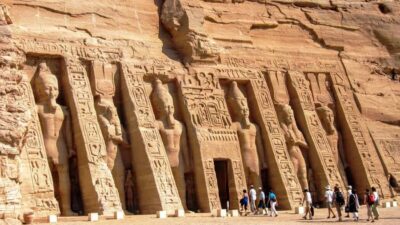
4-Day 3-Night Nile Cruise from Aswan to Luxor&Abu Simbel+Balloon
Read our review →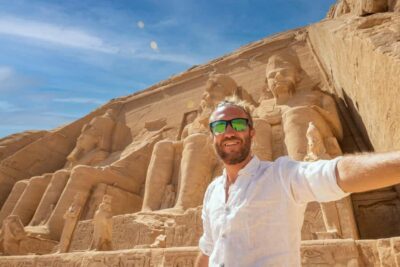
Abu Simbel Temple Private Guided Day Trip with Lunch
Read our review →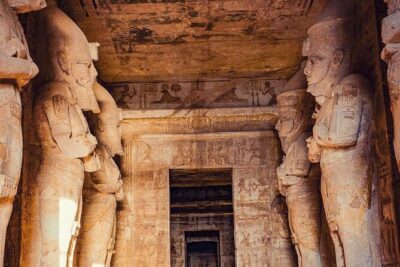
Private Day Tour to Abu Simbel Temples from Aswan
Read our review →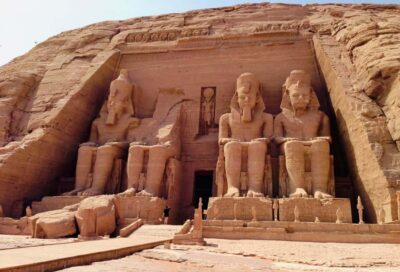
Abu Simbel Group Tour with Guide and Entrance Fees
Read our review →
4 Days Nile Cruise Luxor Abu Simbel & Air Balloon
Read our review →Browse the lists this tour appears in