
Reviewed · GIZA PYRAMIDS & SPHINX TOURS
Full-Day Tour to Giza Pyramids, Memphis, and Sakkara
Giza’s pyramids are the headline, but Saqqara is the surprise. Here you can follow the story of pyramid building from the Step Pyramid of Djoser to the smaller pyramids of Unas and Teti, then see ordinary Egyptian life carved into the Mastaba of Ti. Memphis adds the old capital’s fallen grandeur, including its huge statue of Ramses II.
I like the private format, since you can ask for more explanation, slow down for photographs, or skip an optional add-on. I also like the practical package: air-conditioned transport, bottled water, lunch, hotel pickup, and an Egyptologist guide for $45 per person. The main catch is that some guides may include perfume, papyrus, cotton, or carpet shops, and the day can feel rushed if you want long, quiet time at every site.
Key points to know before booking
- Giza is only part of the day: You also visit Memphis, Saqqara, the Step Pyramid, and three important Old Kingdom tomb sites.
- The private car matters: You travel with only your group, making it easier to adjust the pace and ask questions.
- Saqqara rewards history-minded visitors: The Pyramid Texts inside Unas’s pyramid and the daily-life scenes in Ti’s tomb add depth beyond the famous monuments.
- Basic entrance is covered: Entering the interiors of the Giza pyramids is an optional extra, not part of the standard price.
- Shopping stops may appear: Allow time for perfume, papyrus, cotton, and handmade carpet visits, or clearly say you want to focus on antiquities.
- Guide quality shapes the day: Guides including Ehab, Marwa, Rawan, Tonsi, Mohammad, Osama, and Samir have been singled out for clear explanations, patience, and good organization, but the assigned guide can vary.
Why this Cairo day trip covers more than the usual pyramid visit
At $45 per person, this is an unusually full day for a private tour. You are not paying only for a ride to Giza and back. The price includes hotel pickup and drop-off, private transport, a guide, entrance fees for the basic areas, lunch at a local restaurant, and bottled water.
That matters in Cairo. Giza, Memphis, and Saqqara are separate places, and fitting them together on your own means arranging transport, judging opening times, and handling vendors at each stop. Here, the driver and guide manage the transfers while you concentrate on the monuments.
The trade-off is time. Eight hours sounds generous, but the route includes three pyramid complexes, the Sphinx, Memphis, Saqqara, three pyramids, and a tomb. You will see a lot, yet you will not have unlimited time to sit in one place. I would choose this tour if you have one free day in Cairo and want a broad introduction rather than a slow archaeological study.
The tour begins at 8:00 a.m. with pickup from your hotel. Since it is private, only your group participates. That is useful for families, couples, and anyone who wants to ask questions without competing with a large group.
Other ways to see the pyramids from Cairo:
- Cairo: Pyramids & Great Sphinx Private Tour with Camel Ride
★ 4.9 · 6,335 reviews - Tour to Giza Pyramids and The Egyptian Museum
★ 5.0 · 6,016 reviews - VIP All inclusive Best of the best Giza Pyramids,Sakkara,Memphis
★ 5.0 · 3,164 reviews
Giza Plateau: the great pyramids in one sweep
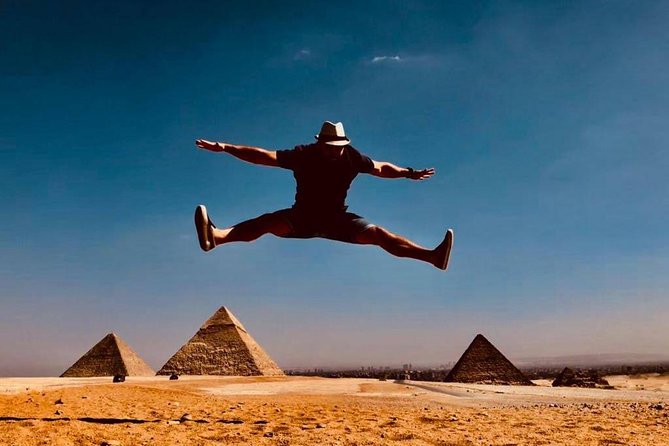
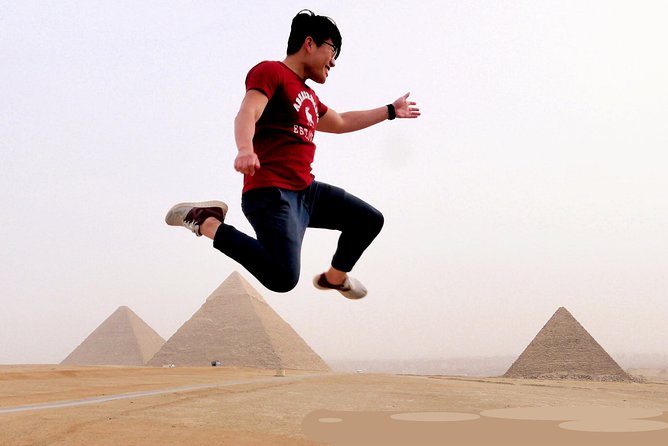
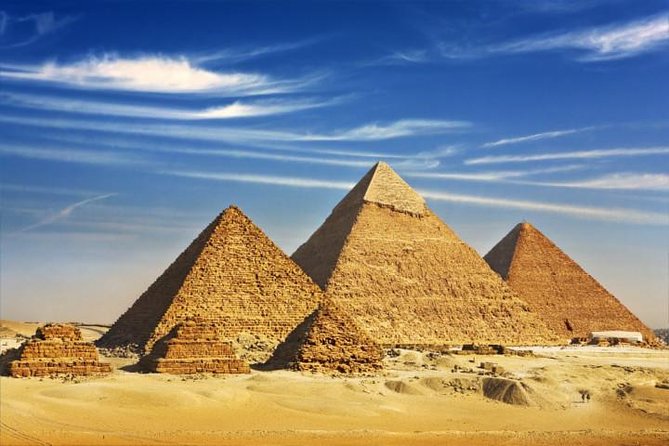
The Giza Plateau is the visual centerpiece. You see the pyramids of Khufu, Khafre, and Menkaure, then visit the Valley Temple and the Great Sphinx. The main Giza visit is planned for about three hours, with roughly 30 minutes set aside for each major pyramid and the Sphinx.
The scale is hard to grasp from photographs. Khufu, also called Cheops, is the largest of the three. Its pyramid complex once included a valley temple, now buried beneath the village of Nazlet el-Samman, along with a paved approach and limestone walls. The remains are not an excavated sight in the same way as the pyramid itself, so your guide’s explanation helps connect the missing pieces.
Khafre’s pyramid is easy to recognize because part of its smooth outer casing remains near the top. Its complex included a valley temple, causeway, mortuary temple, and the Sphinx Temple. Several statues of Khafre were found in the valley temple, including important seated images discovered in the nineteenth century.
Menkaure’s pyramid is smaller, but its complex adds another useful layer to the story. It included a valley temple, causeway, mortuary temple, and royal pyramid, with statues found in both temple areas. The size difference between the three pyramids helps you understand that Giza was not one single building project, but a royal cemetery developed across successive reigns.
The Great Sphinx receives about 30 minutes. Its lion body and human head are linked to Khafre’s reign, and the nearby temple was later connected with the god Hauron-Haremakhet during the New Kingdom. This is a good place to ask your guide about how Egyptians continued to reinterpret older monuments.
Expect vendors and people offering camel or horse rides around Giza. You may also be approached for photographs or tips. Guides such as Ehab and Osama have been praised for warning people about these encounters and helping with photographs, but you should still decide in advance what you want to buy and what you do not.
Entering a pyramid: an optional choice, not a must
The standard package covers the basic archaeological area, but entering one of the pyramids costs extra. That distinction matters when comparing the low price with other Cairo tours.
The interior experience is not for everyone. You may need to climb inclined passages, duck through low sections, and move through tight tunnels without ventilation. It can be hot and uncomfortable, especially if you dislike enclosed spaces or have trouble with steep, cramped routes.
You do not need to enter a pyramid to appreciate Giza. The exterior views, the arrangement of the three pyramids, and the Sphinx already fill the morning. If you want to go inside, ask your guide for the current price and which pyramid is available before paying.
Memphis: Egypt’s first great capital
The route then moves south to Memphis, an ancient capital dating to about 3100 B.C. The stop is planned for around an hour and focuses on the colossal statue of Ramses II and the Alabaster Sphinx.
Memphis is a different kind of sight from Giza. You are not looking at a complete royal complex rising above the desert. You are looking at surviving pieces of a city that once directed much of ancient Egypt. The fallen Ramses II statue is especially striking because of its scale and the detail that remains in the face and body.
The Alabaster Sphinx provides another point of comparison with Giza’s limestone Sphinx. Your guide can help you understand how royal images, temples, and religious centers worked together in Memphis.
This stop is best for people who want context. If your only goal is a photograph beside the pyramids, Memphis may feel less dramatic. If you want to understand why the pyramid fields developed around an important capital, it earns its place on the route.
Other older-pyramid days out of Cairo:
- From Cairo: Pyramids of Giza, Sphinx, Saqqara & Memphis Tour
★ 4.7 · 3,110 reviews - Cairo: Pyramids, Sakkara & Memphis Tour with Lunch
★ 4.6 · 2,493 reviews - Private Day Tour Giza Pyramids, Sphinx, Memphis, and Saqqara
★ 4.5 · 904 reviews - Private tour: GIza Pyramids, Memphis City & Sakkara Pyramid
★ 5.0 · 637 reviews
Saqqara and the Step Pyramid of Djoser
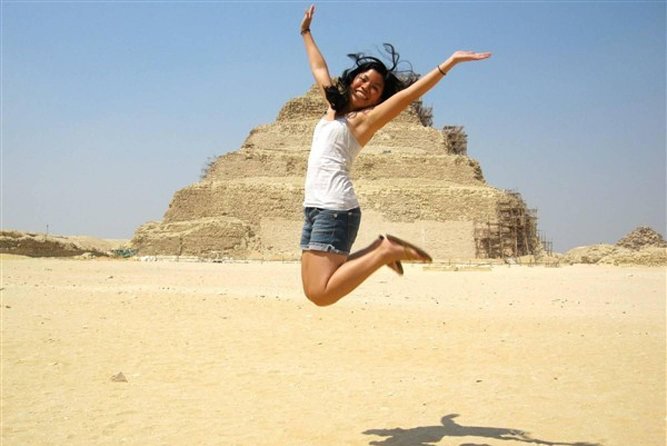
Saqqara lies about 27 kilometers southwest of Cairo and is the historical payoff of the afternoon. The Step Pyramid of Djoser marks a major change in royal architecture. Earlier tombs used the simple mastaba form, while Djoser’s monument built one level above another to create the stepped form.
Your visit here lasts about an hour, though the exact pace can vary. The site is spread out, and the heat can make even short walks tiring. Comfortable shoes, water, and a willingness to follow your guide’s route will help.
The Step Pyramid is not simply a smaller version of Giza. It belongs to an earlier stage of pyramid design, so seeing it after Giza reverses the usual story. Some guides prefer to begin at Memphis and Saqqara, then finish at Giza because the architectural sequence becomes easier to follow. If you care about chronology, ask your guide if that order is possible.
This is one of the strongest reasons to book a private tour. You can ask your guide to explain the shift from mastaba tombs to stepped pyramids, rather than rushing past the details for a quick photograph.
Pyramid of Unas and the first Pyramid Texts
The Pyramid of Unas is scheduled for about 30 minutes. It is the smallest Old Kingdom pyramid on this route, but its importance is not based on size.
Inside are Pyramid Texts, spells carved into the underground chambers to help the king in the afterlife. These inscriptions were first recorded in a pyramid at Unas, and later funerary traditions continued through the end of the Old Kingdom and into the Middle Kingdom.
This stop rewards a guide who can explain what you are seeing. Without context, the pyramid may look modest after Giza. With context, it becomes a key point in the development of Egyptian funerary writing.
Ask ahead about interior access and the conditions inside. The tour includes the basic area, while optional entrances and added activities may cost more.
Pyramid of Teti: a short but worthwhile stop
The Pyramid of Teti receives about 15 minutes, making it the quickest archaeological stop. Teti was the first king of Egypt’s Sixth Dynasty, and the pyramid served as his burial place.
Fifteen minutes is enough for a focused explanation and a look at the site, but not enough for a slow examination. If Teti interests you, tell your guide early. A private itinerary gives you a better chance of shifting time from a less important stop, though the day still has a fixed end point.
The value here comes from comparison. After seeing the grand monuments at Giza and the architectural experiment at Djoser, Teti helps you track how royal burial traditions continued and changed.
Mastaba of Ti and scenes of everyday life
The Mastaba of Ti is another short stop, planned for about 15 minutes. It is one of Saqqara’s important tombs and was discovered by Auguste Mariette.
The tomb’s walls show scenes from daily life. You can see why this kind of site balances the royal monuments so well. Pyramids tell you about kingship and burial, while tomb reliefs show work, farming, food production, boats, and other activities connected with life along the Nile.
The time is brief, so listen closely to the guide’s explanation. A strong guide such as Marwa or Rawan can make the scenes easier to read and point out details you might miss on your own. If your interest is archaeology rather than souvenir shopping, make that clear when the schedule is discussed.
Lunch, transport, and the practical rhythm of the day
Lunch is included at a local restaurant, with koshari listed as the meal. Koshari is a filling Egyptian dish made from a mixture of grains, pasta, lentils, tomato sauce, and other toppings. Bottled water and snacks are also included, which is helpful during a warm day with several outdoor stops.
The vehicle is air-conditioned, and hotel pickup and return are included. That is more than a comfort detail. Cairo traffic can make a self-organized day tiring, while a private driver lets you rest between sites.
The overall pace is active. You move between monuments, walk outdoors, and make several short visits. If you have mobility concerns, tell the operator when booking. A few people have had guides and drivers adjust the pace for older travelers or mobility needs, but the route still involves uneven ground, walking, and pyramid interiors if you choose those extras.
The shopping stops you should discuss at the start
The published experience includes 20-minute stops at places connected with natural oils, Egyptian cotton, papyrus, and handmade carpets. These are described as government stops or places selling government-approved souvenirs.
Some people enjoy seeing papyrus making or watching rugs being woven. Others find these visits interrupt the ancient sites and create pressure to buy. The safest approach is to state your preference at the beginning: ask for the listed archaeological stops first, and ask whether shopping visits are optional.
You should also be ready to say no clearly. Several accounts describe pressure to buy products or pay tips to people offering photographs and other services. A guide may help manage this, but you remain responsible for your money. Agree on any camel ride, horse ride, photograph, or extra service before it begins.
The guide can make or break the experience
The private format gives you access to an Egyptologist guide, but the quality of the day depends heavily on who is assigned. Strong reports have singled out Ehab for patience, Tonsi for accommodating requests, Marwa for clear explanations and handling vendors, Rawan for humor and a relaxed pace, and Mohammad for working well with families and arranging added activities.
Osama has been praised for site explanations and photography help. Samir and driver Youssef have also been associated with a well-organized day. These names are useful when discussing preferences with the operator, but you should not assume a particular guide is guaranteed unless the booking confirms it.
English ability and enthusiasm can vary. If your guide gives only brief explanations, ask direct questions about the chronology, the tomb inscriptions, and the purpose of each temple. A private tour works best when you use that freedom.
Is $45 good value?
For $45 per person, the inclusions are strong: private transport, hotel pickup and drop-off, a guide, basic entrance fees, lunch, bottled water, and snacks. You also cover three major archaeological areas in one day, which would be hard to coordinate for the same cost without a guide and driver.
The value is highest if you are in Cairo briefly, want to see the main sights, and prefer a private vehicle to public transport. It is also a sensible choice for families, since the schedule can be adjusted and the car offers breaks between stops.
The value is weaker if you want long, unhurried visits or dislike commercial stops. You may also spend more if you add pyramid interiors, camel rides, or other optional activities. Ask for the full cost before agreeing to extras.
Should you book this tour?
Book it if you want one efficient day covering Giza, Memphis, and Saqqara, especially if this is your first time in Cairo. The mix is excellent: famous pyramids, an ancient capital, the first major stepped pyramid, Pyramid Texts, and tomb scenes showing daily life.
Choose another arrangement if you want to spend most of a day at Giza alone, avoid all shopping visits, or study each monument at a slow pace. If you book, start by stating your priorities, confirm which entrances are included, and ask the guide to protect time for Saqqara and the tombs. With those expectations clear, this is a strong-value introduction to Egypt’s Old Kingdom sites.
FAQ
How long is the tour?
The experience lasts approximately eight hours.
What time does the tour start?
The stated start time is 8:00 a.m.
Is hotel pickup included?
Yes. Hotel pickup and drop-off are included.
Is this a private tour?
Yes. Only your group participates in the activity.
What sites are visited?
The route includes the Giza Plateau, the pyramids of Khufu, Khafre, and Menkaure, the Great Sphinx, Memphis, Saqqara’s Step Pyramid, the Pyramid of Unas, the Pyramid of Teti, and the Mastaba of Ti.
Is lunch included?
Yes. Lunch at a local restaurant is included, with koshari listed as the meal.
Are pyramid interior entrances included?
No. Entering any of the pyramids is an optional activity and is not included in the basic package.
Can I cancel for a full refund?
Yes, if you cancel at least 24 hours before the experience’s start time. Cancellations made less than 24 hours before the start time are not refunded, and changes within that period are not accepted.
Just added in Cairo
- 2 days 1 night Luxor,Aswan & Abu simbel by flight from Cairo★ 4.5 · 20 reviews
- CAIRO LAYOVER EXCURSION TO GIZA PYRAMIDS SPHINX COPTIC CAIRO and BAZAAR★ 5.0 · 34 reviews
- Cairo Layover Tours To Giza Pyramids Memphis Sakkara Dahshur Pyramids And Bazaar★ 5.0 · 35 reviews
- Giza Pyramids Sound & Light Show At Night★ 4.0 · 74 reviews
- Islamic Cairo Walking Tour: Khan el Khalili, Al-Azhar Mosque★ 5.0 · 96 reviews
- Cairo Food Tours & adventures +30 Tastings★ 5.0 · 146 reviews
- All Inclusive Private Cairo Layover Tour from Cairo Airport★ 5.0 · 50 reviews
- Professional Photo Shoot & Authentic Cairo Walking Tour★ 5.0 · 78 reviews
Giza Pyramids & Sphinx Tours, compared.
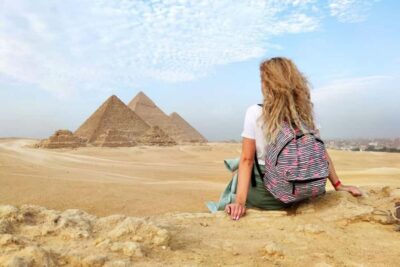
Pyramids & Great Sphinx Private Tour with Camel Ride
Read our review →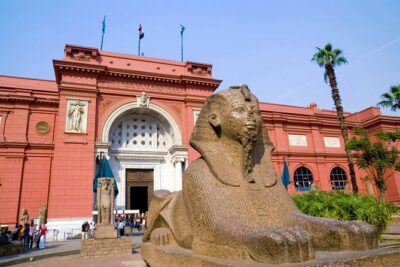
Tour to Giza Pyramids and The Egyptian Museum
Read our review →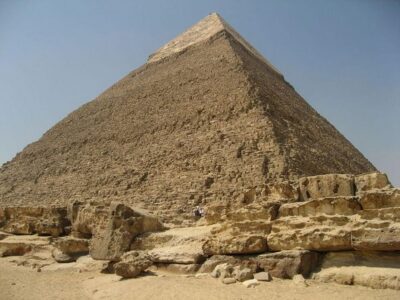
VIP All inclusive Best of the best Giza Pyramids,Sakkara,Memphis
Read our review →
Pyramids of Giza, Sphinx, Saqqara & Memphis Tour
Read our review →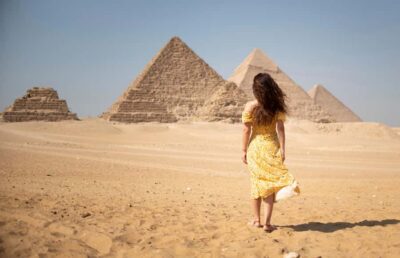
Half-Day Tour to Pyramids of Giza and the Sphinx
Read our review →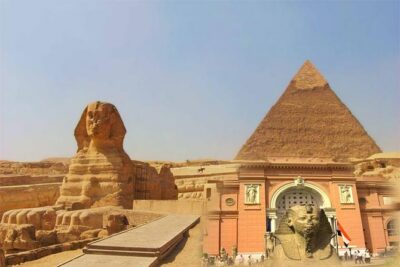
Private ViP all-inclusive Giza Pyramids,Sphinx,Inside Pyramid
Read our review →
Grand Egyptian Museum, Pyramids, Sphinx Tour & Lunch
Read our review →
Cairo Pyramids, Sphinx & Egyptian Museum Day Trip
Read our review →Browse the lists this tour appears in