
Reviewed · VALLEY OF THE KINGS & LUXOR WEST BANK
Private Full-Day Luxor Highlights East and West Banks
The best thing about this private Luxor tour is its range. In one long day, you move from the painted burial chambers of the Valley of the Kings to the giant columns of Karnak, with Hatshepsut’s temple, the Colossi of Memnon, and Luxor Temple in between. You get the big picture of ancient Thebes instead of seeing one monument in isolation.
I like the one-to-one guiding, which lets you ask questions and set the pace, and I like the hotel pickup, lunch, and air-conditioned vehicle bundled into the $65 price. The main drawback is that entrance fees are extra, and the schedule is ambitious. You will see a lot, but this is not a slow, unhurried visit to every tomb and temple.
Key points to know before booking
- Four royal tombs are included in the planned Valley of the Kings visit, with Ramses IV, Ramses III, Merenptah, and another royal tomb listed in the program.
- Tutankhamun’s tomb is optional, with an additional entrance fee of 300 EGP and a chance to see the young pharaoh’s mummy.
- The private format matters, since guides including Mahamoud, Ameen, Hassan, Khalid, Ragab, Hamdee, and Abdul have been praised for clear explanations and flexible pacing.
- Lunch, hotel pickup, and drop-off are included, while all archaeological site tickets are paid separately.
- Karnak gets serious time, including its Hypostyle Hall, obelisks, Sacred Lake, and Temple of Amun.
- A stone shop may be included in the route, so make it clear that you do not want to stop for shopping if that is not part of your plan.
Why this full-day Luxor route works
Luxor is split by the Nile, but the sights are also split by purpose. The East Bank was the city of the living, with grand temples used for worship and festivals. The West Bank held royal tombs and mortuary temples, linked to the setting sun and the afterlife.
That division gives this tour a strong shape. You begin among the tombs of the West Bank, then visit memorial temples and statues before crossing to the East Bank for Karnak and Luxor Temple. By the end, you have seen both the funerary and religious sides of ancient Thebes.
The tour begins around 8:00 a.m. with pickup at your Luxor hotel. The advertised duration is about eight hours, with roughly seven hours of guided sightseeing in a private vehicle. That timing is useful if you have only one full day in Luxor, but the number of planned stops means you should expect a busy day.
The private setup is more than a comfort feature. You are not tied to the questions or pace of a large group. Guides such as Ameen, Hassan, Ragab, Khalid, Hamdee, Abdul, Mahamoud, and Mohamed are named in the tour’s guide team and feedback, with particular praise for clear English, good timing, historical detail, and an ability to give you free time after an explanation.
Other west bank days out of Luxor:
- Hurghada: Luxor Valley of the Kings & Tutankhamun Tomb Trip
★ 4.7 · 13,208 reviews - Luxor Day Trip from Hurghada Small Group & Tutankhamun Tomb
★ 4.8 · 5,366 reviews - Luxor Day Tour: Valley of Kings & Queens & Hatchepsut Temples
★ 5.0 · 1,496 reviews
The Valley of the Kings, where the day begins
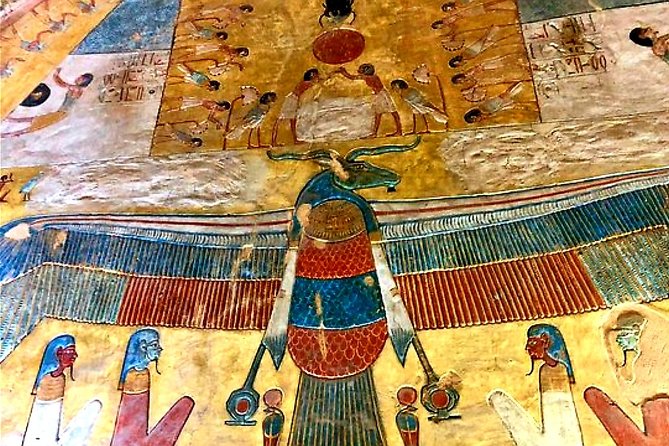
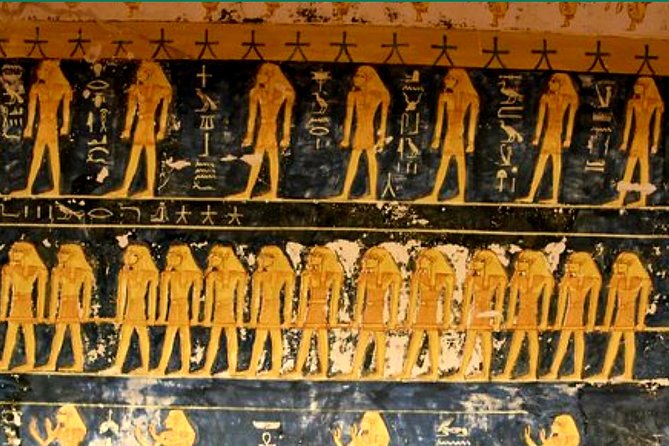
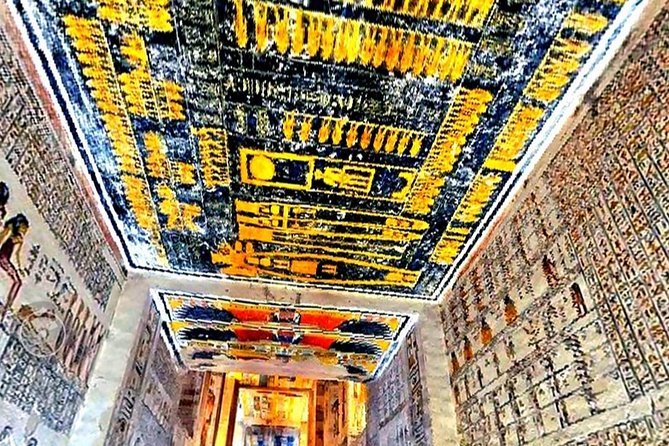
The West Bank portion starts at the Valley of the Kings, the most important stop for understanding royal burial in New Kingdom Egypt. The valley contains tombs cut into the rock, with passages and chambers covered in religious texts, images of gods, and scenes designed to help the dead king reach the next world.
The planned visit includes four royal tombs. The itinerary specifically names Ramses IV, Ramses III, Merenptah, and another royal tomb among the main selections. Exact tomb access can change, so your guide will help direct you to the available choices on the day.
Ramses IV’s tomb is a strong early choice. Its walls contain sections from several religious books, including the Book of the Dead, the Book of Caverns, the Book of Amduat, and the Book of the Night. The burial chamber has a rose-colored granite sarcophagus, and the ceiling features Nut, the sky goddess, swallowing and giving birth to the sun.
Ramses III’s tomb is also worth your attention. Along with standard religious scenes, it has unusual side chambers showing foreign tribute, weapons, boats, pottery, and blind harpists. Those details give the tomb a glimpse of royal life beyond the usual procession of gods and symbols.
Merenptah’s tomb has a different feel. It was built for the son of Ramses II and has unusually tall corridors and chambers. The design changed from the bent or jogged axis used in many earlier royal tombs, making the space itself part of the story.
Your guide can explain how to read the walls, but do not expect to absorb every inscription in one visit. The tombs are visually dense, and the heat outside can make repeated climbs and descents tiring. Comfortable shoes, water, and a hat will make this part easier.
Tutankhamun’s tomb and the extra ticket
Tutankhamun’s tomb is an optional addition. The extra entrance fee is listed as 300 EGP, and the main attraction is the chance to see the king’s mummy in the burial chamber.
The tomb is small compared with some of the others, but its importance comes from the boy king himself and the discovery of his nearly intact burial treasure. The tour description notes that Tutankhamun became king at around age 10 and died at 19.
I would treat this as a personal choice rather than an automatic must. If you are fascinated by Tutankhamun, the additional ticket may feel worthwhile. If you prefer painted chambers and larger architectural spaces, the standard tomb selection may offer more to see.
Remember that the tour price does not include any entrance fees. This applies to Tutankhamun’s tomb and to the other archaeological sites.
Hatshepsut’s temple at Deir el Bahari
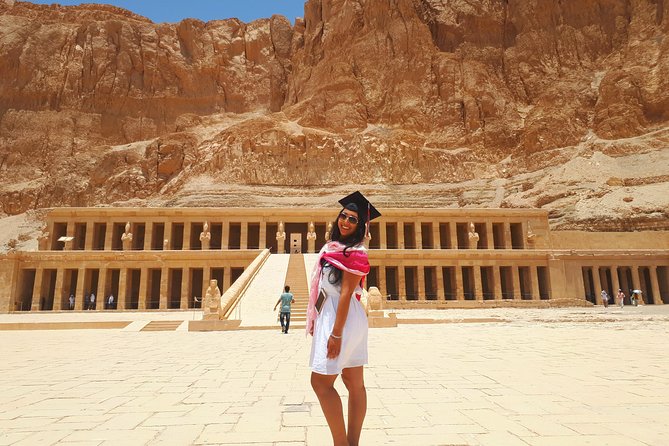
After the tombs, the route continues to the Temple of Hatshepsut at Deir el Bahari. Its broad terraces rise against the cliffs, giving the monument a strong visual contrast with the underground tombs you have just visited.
Hatshepsut ruled Egypt as pharaoh, a rare position for a woman in ancient Egypt. She was an ancestor of Tutankhamun and belonged to the same dynasty. Her temple helped present her rule as legitimate through its architecture, reliefs, and religious connections.
The planned visit allows about an hour here. That is enough time to walk across the main terraces, look at the surviving reliefs, and hear how the temple functioned as a mortuary complex. The sun can be intense, so this is a good point to use a hat and water.
The itinerary also lists the Temple of Merenptah, the Temple of Ramses II, the Mortuary Temple of Seti I, Carter House, the Tombs of the Nobles, Al Asasif, and several additional tombs. These names appear in the broader route details, but the timing does not promise a full visit to each one. Ask your guide at the start which sites are confirmed for your date and which are possible additions.
A few more things to do in Luxor worth a look
- Luxor: Shared Full-Day Tour to Luxor West and East Banks
★ 4.5 · 1,812 reviews - Full Day Tour to East and West Banks of Luxor
★ 5.0 · 1,449 reviews - Luxor : Full Day Tour to Luxor West and East Banks & Lunch
★ 5.0 · 870 reviews - Full Day Tour of Luxor West Bank Temples and Tombs (Private)
★ 5.0 · 722 reviews
The Colossi of Memnon in a quick stop
The Colossi of Memnon are two huge seated statues of Amenhotep III. They once guarded the entrance to a great mortuary temple, most of which has disappeared.
The stop is listed at about 10 minutes. That is enough to walk around the statues, take photographs, and hear the basic story, but not enough for a long archaeological inspection. Think of this as a useful roadside pause between the West Bank temples and the East Bank sites.
The statues are especially impressive because of their scale. After spending time underground in narrow tombs, you suddenly face enormous figures in open air. It is a brief stop, but it breaks up the day well.
Karnak, the biggest block of sightseeing
Karnak is where the tour slows down for its most substantial temple visit. The schedule gives about one hour in one part of the itinerary and two hours for the Temple of Amun elsewhere, so the actual length may depend on the day’s pace and which areas are open.
Karnak is not one temple built by one ruler. It is a huge religious complex developed over many reigns. The main sights include the Avenue of Sphinxes, the Great Hypostyle Hall, obelisks, the Temple of Amun, the Sacred Lake, and a large granite scarab associated with Amenhotep III.
The Hypostyle Hall is the visual high point. Its 134 giant columns once supported a roof, and the scale can make it hard to know where to look first. Your guide’s role is valuable here because the hall is not self-explanatory. A good explanation helps you understand how the columns, reliefs, and processional routes worked together.
The route also calls out the obelisks of Hatshepsut and Thutmose I. One of Hatshepsut’s obelisks remains especially striking for its height and polished stone. The guide can connect these monuments to the rulers who built them and to the religious power of Amun.
The Sacred Lake and granite scarab provide a quieter finish to the complex. Karnak can feel tiring by this point in the day, especially after the Valley of the Kings, so use the free time to sit briefly, take photographs, and look back at the scale of the site.
Luxor Temple and the Avenue of Sphinxes
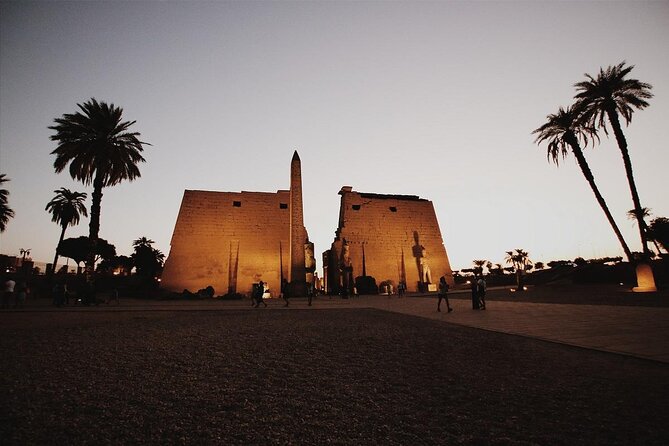
Luxor Temple is the final major monument on the East Bank. It was dedicated to the Theban Triad of Amun-Ra, Mut, and Khonsu, and it includes statues of Ramses the Great.
Unlike Karnak, which feels like a vast temple complex, Luxor Temple has a more concentrated route. You can follow the entrance, courts, columns, and statues without walking across such a broad area. The contrast makes it a good late-day stop.
The Avenue of Sphinxes once connected Luxor Temple and Karnak across roughly three kilometers. Only part of the avenue is available to see today, but the surviving section still gives you a sense of the ceremonial connection between the two temple centers.
The itinerary also names the Obelisk of Thutmose I and the Obelisk of Hatshepsut. Some listed points overlap with the Karnak visit, so do not be surprised if your guide groups several of these monuments together rather than treating each as a separate stop.
Lunch and the private vehicle
Lunch is included, which is helpful on a day with so many sites. The meal is described as taking place at a local restaurant, and one account specifically places lunch on the West Bank near the Nile. Food quality can vary by preference, and one booking found the meal basic, so I would view lunch as practical fuel rather than a major culinary event.
Hotel pickup and drop-off are also included in Luxor. Transport is by air-conditioned vehicle, usually described as a clean car or SUV. One booking raised a concern about the air conditioning, while the provider stated that fresh air had been requested instead, so tell the driver clearly if you want the air conditioning running.
Some roads can be bumpy, especially around the West Bank sites. The driver’s role matters here, and drivers named Alam, Allam, Ramadan, and Said received praise for safe driving and punctual service.
A boat ride across the Nile is not listed as a standard inclusion. One booking received an unexpected boat ride, so do not count on that unless your guide confirms it.
The $65 price and what you still pay
At $65 per person, this tour is priced well for a private full-day outing if you value a guide and vehicle rather than trying to arrange separate taxis. You receive private transport, hotel pickup and drop-off, lunch, and an Egyptologist guide.
The important catch is the entrance fees. Valley of the Kings tombs, Tutankhamun’s tomb, Hatshepsut’s temple, Karnak, Luxor Temple, and other archaeological sites are not included. Your final cost will therefore be higher than the advertised price.
The guide can help with tickets and explain which extras are worth paying for, but you should budget before leaving the hotel. Tutankhamun’s tomb alone is listed at 300 EGP.
The private format is the strongest value here. A taxi can cost less for basic transport, but it will not provide historical explanations, ticket help, or a driver waiting while you visit each site. If you are comfortable arranging a guide and transport yourself, you might save money. If you want one person to coordinate the day, $65 is reasonable.
Shopping stops and how to keep control of your day
One area deserves a direct warning. The route may include a stone shop, and one booking described an uncomfortable sales situation involving small stone figures and unclear prices.
You are allowed to say no. At the start, tell your guide that you want the advertised archaeological sights and do not want shopping stops unless you request them. If you do enter a shop, ask for the full price before showing interest and do not feel obliged to buy.
This does not cancel out the value of the tour, but it is a practical issue to manage. The private format gives you more room to speak up than a large group would.
Who should book this Luxor tour?
I would choose this experience if you have only one day in Luxor and want to see the major East and West Bank sights with context. It suits first-time visitors, families who want a guide to explain the monuments, and anyone who prefers a private vehicle to negotiating transport at each stop.
It is also a good fit if you like asking questions. Guides such as Hamdee and Abdul have been praised for adjusting their explanations to the group, while guides including Hassan and Khalid have been singled out for clear historical teaching and a friendly manner with children.
I would be more cautious if you want a slow archaeological study. The itinerary covers a great deal in about eight hours, and some stops are short. For a relaxed visit, you would need to ask about dropping lesser stops or focusing on fewer tombs.
Should you book it?
Book this tour if your priority is seeing Luxor’s essential sights in one day with a private guide, lunch, and hotel transport. The strongest parts are the broad route, the guide-led explanations, and the freedom to explore after each introduction.
Before paying, confirm the exact tombs and temples planned for your date, ask about any shopping stop, and budget separately for entrance tickets. If you accept the full schedule and extra site fees, this is a practical and well-priced way to cover both banks of the Nile.
FAQ
How long does the Luxor highlights tour last?
The experience lasts approximately eight hours. The itinerary describes about seven hours of guided touring, beginning with hotel pickup around 8:00 a.m.
Is hotel pickup included?
Yes. Pickup and drop-off at Luxor hotels are included.
Is this a private tour?
Yes. Only your group participates in the private activity.
Is lunch included?
Yes. Lunch is included in the tour price.
Are entrance fees included?
No. All entrance fees are paid separately, including tickets for the Valley of the Kings, Hatshepsut’s temple, Karnak, Luxor Temple, and optional tombs.
Can I visit Tutankhamun’s tomb?
Yes. Tutankhamun’s tomb is an optional visit in the Valley of the Kings. The listed extra entrance fee is 300 EGP.
Which tombs are included in the Valley of the Kings visit?
The planned visit names the tombs of Ramses IV, Ramses III, and Merenptah, along with a fourth royal tomb. The exact selection may depend on site access.
Is transport air-conditioned?
Transport is provided in an air-conditioned vehicle. One booking raised an air-conditioning concern, so tell the driver clearly if you want the system running.
Can most people take part?
Yes. The tour information says most people can participate.
Can I cancel for a full refund?
Yes, if you cancel at least 24 hours before the local start time. Cancellations made less than 24 hours before the tour are not refunded, and changes within that period are not accepted.
Just added in Luxor
- From Luxor: 5-Day Nile Cruise to Aswan with Balloon Ride★ 4.2 · 168 reviews
- Book online Sound and Light Show at Karnk Temple in Luxor★ 4.2 · 61 reviews
- Dendara and Abydos Temples Day Tour from Luxor★ 4.5 · 133 reviews
- Private Half-day: Dendera Temple From Luxor★ 5.0 · 132 reviews
- Luxor Day Tour Visit Dendara And Abydos Temples★ 4.6 · 151 reviews
- 2-Day Top Attractions and Adventures Package in Luxor with Accommodation★ 5.0 · 178 reviews
- Luxor: West & East Banks & Tut’s Tomb Private Full-Day Tour★ 4.8 · 173 reviews
- Marsa Alam: Valley of the Kings & Karnak Temples Luxor Tour★ 4.6 · 177 reviews
Valley of the Kings & Luxor West Bank, compared.
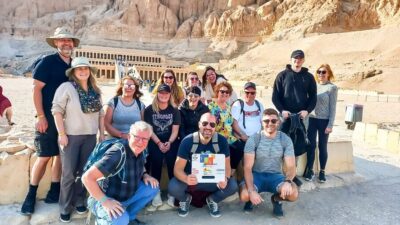
Luxor Valley of the Kings & Tutankhamun Tomb Trip
Read our review →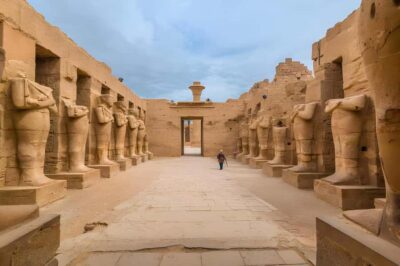
Luxor Day Trip from Hurghada Small Group & Tutankhamun Tomb
Read our review →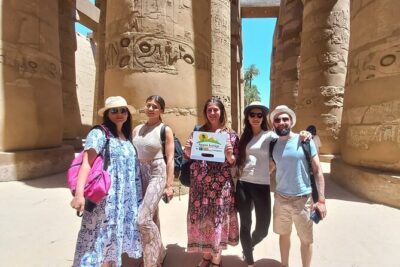
Small group Hurghada to Luxor, Valley of the Kings by Van
Read our review →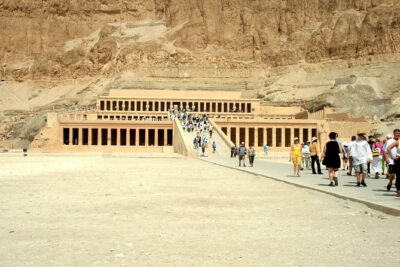
Luxor Day Tour: Valley of Kings & Queens & Hatchepsut Temples
Read our review →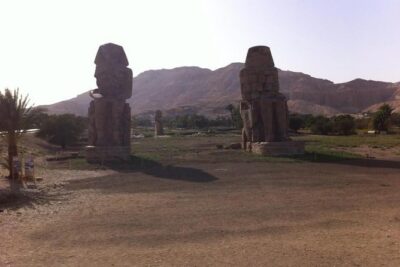
Full Day Tour to East and West Banks of Luxor
Read our review →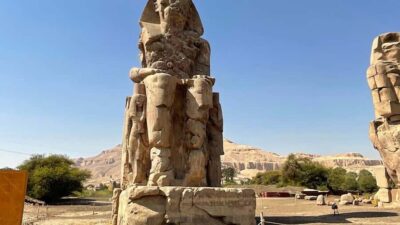
Valley of the Kings and Hatshepsut Temple Day Tour
Read our review →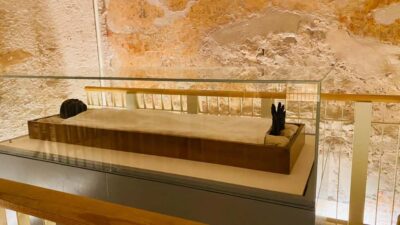
Luxor Tour with Valley of Kings, Karnak & Tut Tomb
Read our review →
Small-Group Luxor Highlights & Tut Tomb Day Tour
Read our review →Browse the lists this tour appears in